
Immune-Support Peptides: The Confusion Cleared Up Before You Spend a Penny
You searched “immune-support peptides,” and now you’ve got a browser full of tabs, each one selling you certainty. Here’s the thing none of them will say out loud: you’re not looking at one product. You’re looking at five completely different molecules that got shoved into the same shopping category because they’re all loosely tied to your immune system, nothing more. Buy them as if they’re interchangeable and you’ll likely end up with the wrong one, or with something that has barely any human evidence behind it at all.
Let’s slow down and sort this properly. Most of what’s in this category isn’t FDA-approved for immune use in the US. Several only reach American buyers as compounded prescriptions, or as “research” powders with no medical oversight whatsoever. Read this before you check out, not after.
First, let’s clear up what you’re actually buying
When a website says “immune peptides,” it usually means some combination of five things: thymosin alpha-1, thymulin, LL-37, glutathione, and VIP (vasoactive intestinal peptide). They’re grouped together to make your shopping easier, not because they work the same way in your body.
Here’s the plain-English version of each:
- Thymosin alpha-1 is a piece of a thymus protein that helps your T-cells (a key immune cell) mature properly.
- Thymulin is a hormone from your thymus that only works if it’s bound to zinc, a detail that turns out to matter enormously.
- LL-37 is something your own body already makes, an antimicrobial peptide involved in defense and wound healing.
- Glutathione isn’t really a “peptide” in the way most people picture the word. It’s a tiny antioxidant molecule your cells produce all day, every day.
- VIP is a neuropeptide (a nerve-signaling molecule) that calms inflammation in your lungs and gut.
Five molecules. Five different jobs. Five separate piles of evidence. Any product page that lines these up as five flavors of “immune boost” is telling you a tidy story that just isn’t true. So here’s the checklist mindset to bring instead: stop treating this as one decision. Treat it as five.
Who’s this actually for?
Let me save you some money right now. If you’re a healthy person hoping to “boost” an immune system that’s already doing its job, none of these five has proof that it does that. That’s not me hedging for legal reasons, that’s what the actual human studies show, compound by compound, below. The marketing aimed at healthy biohackers is way out ahead of the science.
The people these molecules genuinely have some clinical footing for are narrower than the marketing suggests. Thymosin alpha-1 has been studied in people with chronic viral hepatitis and in critically ill sepsis patients, not in healthy adults chasing an edge [1][3]. The real LL-37 evidence is about healing a stubborn skin wound, not injecting yourself to dodge a cold [6].
If you’re in the “I just want to feel healthier” camp, be honest with yourself: the gap between what’s sold and what’s proven is wide, and your money is probably better spent elsewhere for now.
If you do have a specific medical situation you’re weighing this for, that’s a conversation for a licensed clinician who can actually look at your history, not something you decide off a product grid. Which leads to the part that matters most.
The one decision that protects you more than any other
Here’s the twist most buying guides skip past. Because these five molecules are so wildly different, and because several of them are injectables, the biggest choice you make isn’t which peptide to pick. It’s who you get it from. That single decision decides whether a medical professional ever looks at your case, whether the product is made to a real pharmacy standard, and whether what’s actually in the vial matches what the label promises.
The market has split into two things wearing the same label. On one side: licensed telehealth and pharmacy setups, where a clinician reviews your history, a prescription gets written if it’s appropriate, a licensed pharmacy makes the product, and someone checks in with you afterward. On the other side: research-chemical retailers, where you toss a vial in a cart, tick a box claiming it’s “for laboratory research only,” and a powder shows up with zero medical involvement.
In a category where one of these compounds has a documented injectable-contamination problem and another can literally turn your own immune system against you, that difference isn’t a nice-to-have. It’s the safety information. Details on both, coming up.
The evidence, molecule by molecule (this is the part worth reading slowly)
Thymosin alpha-1: the one with real receipts
This one’s the standout, and it isn’t close. The synthetic version, thymalfasin (sold abroad as Zadaxin), is approved in more than 35 countries for hepatitis B and C. It has a real, described mechanism, working through TLR-2 and TLR-9 receptors to help normalize T-cell function [1]. That’s a genuine drug with a genuine track record in much of the world.
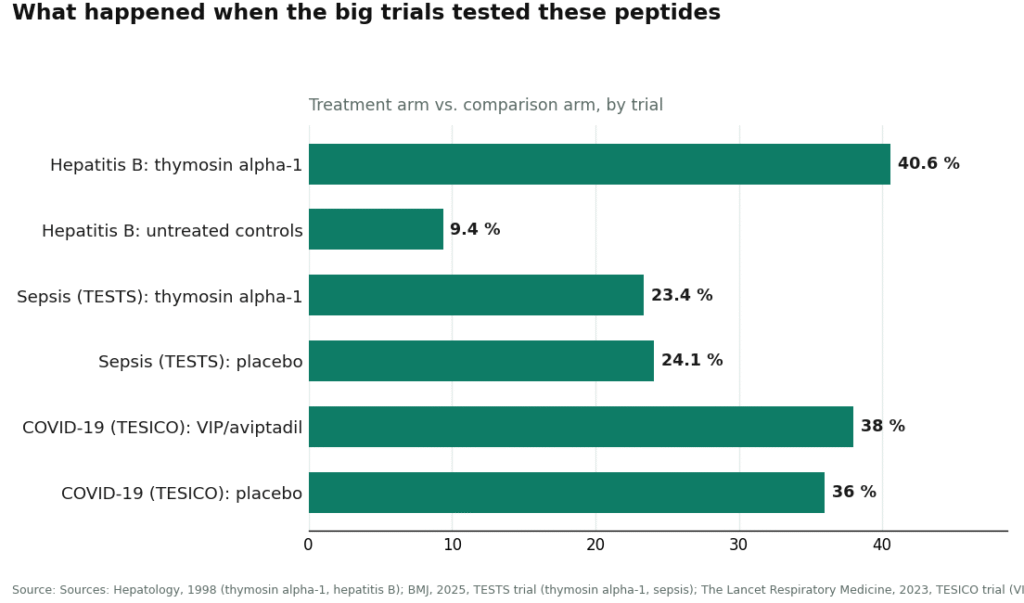
The trials back it up, but read them carefully, because the story shifts. A 1998 randomized controlled trial in 98 chronic hepatitis B patients found a 26-week course produced a full virological response in 40.6% of treated patients, versus 9.4% of untreated controls [2]. That’s a strong result. But watch what happens when the question gets bigger and harder: the large TESTS trial randomized 1,089 sepsis patients, and 28-day mortality came out at 23.4% with the peptide versus 24.1% with placebo, essentially no difference [3]. That’s the pattern you’d expect from a real medicine that isn’t magic: the benefit shrinks as the trials get bigger and better designed. It’s not approved in the US as a general immune treatment, so here it’s only available through compounding, with a prescription.
Thymulin: solid biology, thin modern trials
Thymulin is a genuine zinc-dependent hormone from your thymus, and it literally does nothing without bound zinc attached [5]. Here’s the most useful, least flashy fact about it: as your thymus shrinks with age, it keeps producing the thymulin peptide at near-normal levels, but the active, zinc-bound version nearly disappears. Add zinc back in the lab, and secretion recovers [5]. Reviews describe it shaping T-cell development with anti-inflammatory effects in experimental models [4].
The catch for you as a shopper: thymulin’s modern evidence is mostly mechanistic, lab-based work, not stacks of randomized human trials proving it “supports immunity.” It’s a legitimate hormone, more than you can say for a lot of gray-market compounds, but using it as a treatment goes well past what’s actually been tested in people. The real takeaway here might just be: check your zinc levels.
LL-37: your own defense peptide, with a genuine downside
LL-37 is the only human member of the cathelicidin family of antimicrobial peptides, and it does real work defending your body [10]. The best human evidence is topical: a randomized, placebo-controlled trial of topical LL-37 in 34 patients with hard-to-heal venous leg ulcers found it was safe and helped healing [6]. Legitimate finding, but notice what it is: a wound cream, applied to skin.
LL-37 is also the clearest example in this whole category of why “your body already makes this” doesn’t mean “safe to inject.” Reviews of the cathelicidin family flag toxicity to your own cells at higher doses, plus links to autoimmune conditions like psoriasis and lupus, where LL-37 can act as an autoantigen (meaning your immune system mistakenly targets it) [7]. That double edge is exactly why the casual, injected uses implied by sellers rest on far shakier ground than the careful topical study that actually exists.
Glutathione: real antioxidant, rough delivery
Glutathione is your body’s main internal antioxidant, and it’s probably the one name here you already recognize. The problem is getting it where it needs to go. Plain oral glutathione has essentially negligible availability in your bloodstream, because your gut and liver break it apart before it can circulate, so swallowing it isn’t doing much for your levels [8]. Newer liposomal versions do better: a small one-month study in 12 healthy adults found liposomal glutathione raised body stores and improved some oxidative stress and immune markers [9]. Real, but modest, and in a tiny group of people.
The bigger concern with the injectable version is safety, and it’s not theoretical. The FDA warned compounders not to use a dietary-grade glutathione powder to make sterile injectable products, after a cluster of adverse events and lab-confirmed excessive endotoxin [11]. Sit with that, because it’s the entire argument for caring who makes your product. With an injectable, sourcing and pharmacy standards aren’t background details. They are the safety story.
VIP: interesting signaling, disappointing at scale
VIP is a neuropeptide with broad anti-inflammatory activity. In a small open-label trial, 20 sarcoidosis patients given nebulized VIP saw reduced lung inflammation markers, and it was safe [12]. Then comes the reality check: in the large TESICO randomized trial, IV synthetic VIP for COVID-19 respiratory failure showed no benefit and was stopped for futility, with day-90 mortality at 38% versus 36% on placebo [13]. Promising biology, real human trials, and when tested at scale, mostly no payoff. File this one under interesting, not proven.
How to actually read this, as a buyer
Line the five up by weight of evidence and the picture gets clear fast. Thymosin alpha-1 sits alone at the top, real trials, approvals abroad, even if the benefit shrank under the toughest testing. LL-37, glutathione, and VIP each have exactly one small, specific human study, and none of those studies support the broad “boost your immune system” language stapled onto the products. Thymulin is mostly lab work.
Across the board, the marketing runs way ahead of the data. That gap is information you should use, not something to shrug off.
The checklist to actually use before buying anything:
- Pick one specific molecule for one specific reason. Not “the immune bundle.”
- Know exactly how thick or thin the human evidence is for that one molecule.
- Decide who you’re buying from before you decide anything else.
- If it’s injectable, treat the manufacturer and pharmacy standard as part of the safety profile, not a footnote.
- If you have an actual medical condition in mind, take it to a clinician, not a product grid.
The choice that matters most: who you buy it from
If you land on one of these being worth pursuing, this is where you actually protect yourself, and it lines up directly with the safety facts above. The glutathione endotoxin warning is a sourcing-and-pharmacy problem, not a molecule problem [11]. A model where a licensed pharmacy compounds the product to recognized standards directly answers that risk. A research-chemical vial does not.
FormBlends is one example of that supervised path: a physician-supervised telehealth setup where a licensed clinician reviews your profile, writes a prescription if appropriate, and has the medication compounded by licensed 503A pharmacies. The honest disclosure belongs right here, not buried at the bottom: compounded medications are not FDA-approved finished drug products, and the FDA doesn’t review them for safety, effectiveness, or quality before they hit the market [14]. What the supervised model adds isn’t the compounding itself, it’s the layer on top: a clinician, a prescription, a licensed pharmacy, and follow-up. None of that exists when a powder ships with a “research use only” sticker. That’s the trade-off. Slower than instant checkout. The slowness is the point.
The short version, so you can close the tab
“Immune-support peptides” is really five very different molecules wearing one costume. Most aren’t proven to help a healthy immune system. Thymosin alpha-1 has the strongest evidence, and even that softened once the trials got bigger. The rest range from one narrow human study down to mostly lab work. Several are injectables where contamination is a real, documented risk, which is exactly why who you buy from matters as much as what you buy. Pick a specific compound for a specific reason, know how thin the evidence is, and route it through a licensed clinician and pharmacy instead of a checkout button. That’s the whole guide.
The questions that keep coming up
Are “immune-support peptides” all the same kind of product? No. The label usually covers five very different molecules: thymosin alpha-1, thymulin, LL-37, glutathione, and VIP. They share a loose connection to your immune system but work differently, get delivered differently, and rest on completely separate piles of evidence. Treating them as interchangeable is the most common mistake buyers make, so compare them as five separate decisions, not one bundle.
Which one has the strongest human evidence? Thymosin alpha-1, by a wide margin. The synthetic form, thymalfasin, is approved in more than 35 countries for hepatitis B and C, backed by real randomized trials, including a 1998 hepatitis B trial and the large TESTS sepsis trial. The other four each rest on one small human study, or mostly lab work. The gap is large.
Will any of these boost a healthy person’s immune system? There’s no proof of that. If your immune system already works fine, none of these five is a demonstrated way to make it work “better.” The human evidence that exists is in specific medical situations, chronic hepatitis, sepsis, hard-to-heal wounds, not in healthy people chasing an edge. The marketing aimed at healthy biohackers is running years ahead of the science.
Why does who I buy from matter more than which peptide I choose? Because several of these are injectables, and the access route determines whether a clinician ever reviews your case and whether the product meets real pharmacy standards. A licensed telehealth and pharmacy path includes a prescription and a licensed compounding pharmacy behind it. A research-chemical retailer just ships a “research use only” powder with no medical involvement at all. Given the documented contamination and autoimmune risks in this category, that sourcing gap is the safety information.
Is injectable glutathione safe to buy from a research-chemical seller? The sourcing is the risk. The FDA warned compounders not to use a dietary-grade glutathione powder to make sterile injectable drugs, after a cluster of adverse events and lab-confirmed excessive endotoxin. Who makes the product, and to what standard, is the central safety question for any injectable form here, not a small print detail.
Why is LL-37 risky to inject if my body already makes it? Making something naturally doesn’t make it safe to inject in higher doses. Reviews of the cathelicidin family flag toxicity to your own cells at higher concentrations, plus links to autoimmune conditions like psoriasis and lupus, where LL-37 can act against your own immune system. The one encouraging human study used it topically on leg ulcers, which is a very different thing from injecting it to fend off a cold.
Is it actually safe to use these?
Safety comes down almost entirely to which peptide, what dose, and where it came from. Thymosin alpha-1 has a reasonable human-use track record from clinical settings abroad. Others sold online as “research chemicals” have essentially no meaningful human safety data. Contamination, mislabeling, and dosing errors are real risks with unregulated suppliers, so where it comes from matters just as much as what it is.
Do they actually work, or is this mostly marketing?
Honestly, it varies a lot by peptide. Thymosin alpha-1 has the most clinical data, mostly from trials in immunocompromised patients, not healthy people looking for a general lift. Others rest mostly on animal studies. The gap between “did something interesting in a mouse” and “will help your immune system” is genuinely large, and most marketing just skips right over it.
What do researchers and clinicians actually pay attention to here?
Thymosin alpha-1 gets the most serious clinical attention for immune applications, particularly around T-cell activity. Thymosin beta-4 is studied mainly for tissue repair, with some immune-adjacent effects. LL-37 is another genuine area of research interest. None of these is a clean “winner”; they affect different parts of your immune system, and claiming one beats the rest oversimplifies things.
Where should someone actually buy these if they want a legitimate option?
The most accountable route is through a licensed physician who can prescribe compounded peptides from a regulated pharmacy, with FormBlends operating as one example of that physician-supervised model. Buying raw peptides from research-chemical websites lands you in a legal and safety gray area: no quality guarantee, no dosing guidance, no medical oversight at all. If a site will sell to anyone with a credit card and skips the prescription, take that as a warning sign.
References
- Comprehensive review of thymosin alpha-1: TLR-2/TLR-9 agonist mechanism, T-cell normalization, approval in more than 35 countries as thymalfasin (Zadaxin), generally well tolerated. World Journal of Virology, 2020. https://pmc.ncbi.nlm.nih.gov/articles/PMC7747025/
- Randomized controlled trial of thymosin alpha-1 in 98 chronic hepatitis B patients; complete virological response 40.6% versus 9.4% of untreated controls; concluded effective and safe. Hepatology, 1998. https://pubmed.ncbi.nlm.nih.gov/9581695/
- TESTS trial: multicenter, double-blind, randomized, placebo-controlled phase 3 trial of thymosin alpha-1 in 1,089 adults with sepsis; 28-day mortality 23.4% versus 24.1% (hazard ratio 0.99); no clear benefit. BMJ, 2025.
- Review of thymulin and the thymus-neuroendocrine axis: produced by thymic epithelial cells, influences T-cell differentiation, anti-inflammatory and analgesic properties in experimental models. Annals of the New York Academy of Sciences, 2009.
- Study showing that in age-related thymus involution the gland still produces thymulin peptide while the zinc-bound active form is nearly absent, and adding zinc in vitro recovers secretion. International Journal of Immunopharmacology, 1995.
- Treatment with LL-37 is safe and effective in enhancing healing of hard-to-heal venous leg ulcers: randomized, placebo-controlled trial (topical, 34 patients). Wound Repair and Regeneration, 2014.
- Antimicrobial peptides of the cathelicidin family, focus on LL-37: host-cell cytotoxicity, proteolytic instability, and autoantigen/autoimmune (psoriasis, lupus) associations. International Journal of Molecular Sciences, 2025.
- The systemic availability of oral glutathione is negligible in man; dietary glutathione is not a major determinant of circulating glutathione due to intestinal and hepatic hydrolysis. European Journal of Clinical Pharmacology, 1992.
- Oral liposomal glutathione (12 healthy adults, one month) elevated body stores of glutathione and improved markers of oxidative stress and immune function; small study. European Journal of Clinical Nutrition, 2018.
- FDA warning to compounders not to use a dietary-grade glutathione powder to compound sterile injectable drugs, after a cluster of adverse events and laboratory-confirmed excessive endotoxin. U.S. FDA, 2019.
- Same FDA glutathione injectable-endotoxin warning, cited for the sourcing-and-pharmacy safety point. U.S. FDA, 2019.
- Inhaled VIP exerts immunoregulatory effects in sarcoidosis: open-label phase II trial in 20 patients; nebulized VIP was safe and reduced lung TNF-alpha while increasing regulatory T cells. American Journal of Respiratory and Critical Care Medicine, 2010.
- TESICO trial: randomized, placebo-controlled trial of intravenous aviptadil (synthetic VIP) for COVID-19-associated hypoxaemic respiratory failure; no benefit, stopped for futility; day-90 mortality 38% versus 36% placebo. The Lancet Respiratory Medicine, 2023.
- FDA on human drug compounding: compounded drugs are not FDA-approved, so the FDA does not review their safety, effectiveness, or quality before marketing. U.S. FDA.
Written by Felix Abadi, consumer-affairs writer. Last reviewed January 2026.
General information, not a treatment recommendation. Ask your doctor what fits your situation.